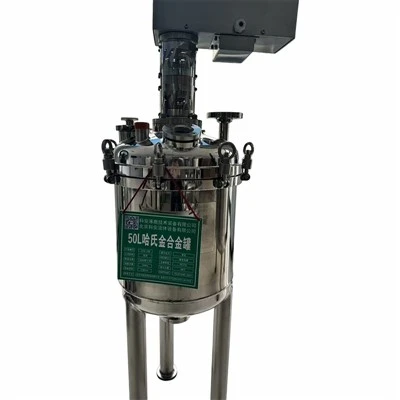
If you’ve ever walked through a food processing plant, a pharmaceutical manufacturing facility, or even a chemical production site, you’ve likely seen them: sturdy, enclosed vessels with large, whirring blades or agitators peeking through the top. As a supplier of these systems, I field questions about them almost every day, and more often than not, the first question isn’t about their specs—it’s about what makes a closed tank with a mixer different from a regular open tank, and why businesses can’t function without them. Let’s break it down, straight from someone who’s spent 12 years designing, building, and troubleshooting these systems for clients across industries. Tank with Mixer

First, let’s define the core components simply, no overly technical jargon that makes your eyes glaze over. A closed tank with a mixer is exactly what it sounds like: a rigid, fully enclosed vessel paired with a mechanical mixing system mounted either on top, side, or submerged deep inside, depending on the job. The “closed” part is non-negotiable for most industrial applications, and that’s where the biggest value lies—way more than just keeping the contents from spilling.
Let’s start with why the closed shell matters, because that’s the feature that separates this setup from the 55-gallon open drum you might have at home for garage chemicals. First, contamination control. If you’re making liquid detergent, mixing food-grade syrup, or processing active pharmaceutical ingredients (APIs), even a tiny amount of dust from the factory floor, ambient microbes, or airborne dirt can ruin a batch. Open tanks leave the entire surface exposed, which is a non-starter for regulated industries. I had a client a few years back that made organic protein powder; they were using an open tank for a liquid pre-mix and lost a full $45,000 batch when a construction crew a few buildings down kicked up mold spores that landed on the surface. Switched to a closed tank mixer setup, and they haven’t had that issue in seven years.
Then there’s safety. Closed tanks let you control pressure, which is critical if you’re working with volatile chemicals, products that react when exposed to air, or processes that require consistent pressure to run. For example, if you’re mixing hydrogen peroxide, it can release oxygen when agitated, and an open tank would let that gas escape into the work area, creating a fire hazard or even an explosion risk if levels build up. A closed tank is rated to hold those gases, with pressure relief valves that vent safely away from personnel, so you don’t have to shut down your process every time the mixer runs. It also keeps toxic or fuming contents inside, so workers aren’t breathing in hazardous fumes—another non-negotiable for OSHA and EPA compliance, which I can’t tell you how many new plant managers overlook at their peril.
Now, the mixer part. This isn’t the hand mixer you use for cake batter (thank goodness). Industrial mixers for closed tanks come in a handful of types, each built for a specific job. Top-entry mixers are the most common for large tanks, 1,000 gallons or more; they sit on a flange bolted to the top of the tank, with a long shaft that goes down into the liquid, spinning blades (impellers) at just the right speed. Side-entry mixers work for tall tanks, where a top-mounted impeller wouldn’t reach the bottom or create consistent flow. There are also magnetic mixers for extremely sensitive products, because they don’t have a shaft that goes through the tank wall—no risk of leakage from a seal wearing out, which is a big plus for pharma and cosmetics.
The job of the mixer in a closed tank is about more than just stirring. It’s about homogeneity. If you’re making a paint, you need the pigment evenly dispersed so the color is consistent from batch to batch; if you’re making a fertilizer, you need solid nutrients suspended in liquid so every application has the same ratio. Without a mixer, dense solids would sink to the bottom, creating a sludge that’s hard to clean, and light oils would float to the top, leaving thin, unbalanced product. I recently worked with a small batch brewery that was using a closed tank without a mixer for their wort (unfermented beer); they’d end up with batches that tasted “flat” because the hops and malt extract weren’t mixing evenly. Swapped in a medium-shear top mixer, and their ABV and flavor consistency went up 20% across all their seasonal brews.
Another key function of the mixer, when paired with a closed tank, is temperature control. Many industrial processes require heating or cooling a mixture to a precise temperature over hours or days. A closed tank can have a jacket around the outside, or coils inside, that circulate hot water or chilled glycol, and the mixer keeps the liquid moving so every part of the tank is at the same temperature. No hot spots that burn the product, no cold spots where bacteria can grow. For a dairy client of mine, that meant they could pasteurize their chocolate milk in 30% less time because the mixer eliminated the cold dead zones at the bottom of the tank, cutting energy costs too—win-win.
Wait, but not all closed tank mixers are the same, right? That’s a question I get all the time, because a system for a food processing plant isn’t going to work for a biofuel facility. Let’s talk about the variations, because size and design depend entirely on your application. Tanks range from 50-gallon pilot systems for R&D labs up to 100,000-gallon behemoths for municipal water treatment. The material matters too: stainless steel is standard for food and pharma because it’s easy to sanitize and doesn’t react with most products. Carbon steel works for non-toxic, low-corrosive chemicals, and specialized plastics like HDPE are used for things like corrosive acids that would eat through steel.
A common mistake I see new buyers make is picking a mixer that’s too powerful or not powerful enough. If you have a tank full of thick, viscous product like molasses or polymer resin, you need a high-torque mixer that can spin the impeller without straining. If you’re mixing thin, water-based solutions, a lower-speed mixer will work just fine, and saves on energy costs. I had a client that ordered a 10-horsepower mixer for a 500-gallon tank of dish soap; the sales rep from another supplier talked them into it, and it was so powerful it created a vortex that sucked air into the liquid, leaving bubbles that ruined their packaging. We swapped in a 3-horsepower low-shear mixer, and their bubble issue was gone overnight.
Cleaning is another big part of using a closed tank with a mixer, especially for industries that require regular sanitation. The closed design means you can use CIP (clean-in-place) systems, where you spray hot, soapy water or sanitizer through nozzles mounted on the tank walls, and the mixer spins to slosh the cleaning solution around every corner, including the impeller. No need to take the whole tank apart to scrub it, which cuts downtime by hours every cycle. Open tanks would require manual scrubbing, which is not only time-consuming but can leave spots that cause cross-contamination between batches.
So why should you invest in one, instead of sticking with your current setup? Let’s weigh the pros, because I’m not here to sell you something you don’t need, but I’ve seen the payoff for clients over and over. First, compliance: if you’re in food, pharma, or chemicals, regulatory bodies require controlled, contamination-free processes, and a closed tank mixer is the most reliable way to meet those standards. Second, cost savings: better homogeneity means less product waste, energy efficiency from consistent temperature control, and less downtime for cleaning and maintenance. Third, safety: protecting your workers from hazardous materials and your facility from explosion or fire risks is non-negotiable, and these systems are built to mitigate those risks.
I should also mention that closed tank mixers aren’t just for big industrial operations. We build compact pilot-scale systems for startups and R&D labs, too—smaller, 50 to 200-gallon tanks that give small businesses the same benefits without the big price tag. A craft CBD client of ours used a 100-gallon closed tank mixer to scale up their extraction process from 5-gallon lab batches, and now they supply 12 regional brands with their product. It’s proof that this tech works for every size, not just Fortune 500 companies.
Now, I want to be honest about the considerations, too, because no system is perfect. The initial upfront cost is higher than an open tank, but when you factor in the savings from reduced waste, lower energy use, and compliance with regulations, it almost always pays for itself within two to three years. Maintenance is something you have to plan for: mixers have seals that need replacing every few years, and tanks need regular inspections for corrosion, but those are scheduled, predictable costs, not emergency breakdowns that shut down your whole process.
I get calls every week from plant managers and owners who have questions about whether a closed tank with a mixer is right for their operation. Some have old open tank setups that are working, but they’re tired of the batch inconsistencies or the safety risks. Others are scaling up and realizing their current system can’t handle the volume or compliance requirements. Whatever your situation is, we tailor every system to your specific needs—no one-size-fits-all here. We’ll ask about what you’re mixing, the volume, the temperature and pressure requirements, the sanitation needs, and even your budget, then design a system that fits, not a pre-built model that doesn’t work for you.
If you’re looking to upgrade your mixing setup, or you’re unsure if a closed tank with a mixer would solve your current pain points, I’m here to talk through it. I’ve spent years working with clients across dozens of industries, and I can help you figure out exactly what you need, no hard sales pitches, no fine print. Just honest advice and a system that works for your process.
When you’re ready to discuss your specific needs, don’t hesitate to reach out for a procurement consultation. We’ll walk through your application, answer all your questions, and help you find a solution that fits your operational and budget requirements.
Tank with Mixer References:
- “Industrial Mixing Handbook, 3rd Edition” by Paul A. Shamlou
- ASME BPVC Section VIII: Rules for Construction of Pressure Vessels
- FDA 21 CFR Part 110: Current Good Manufacturing Practice in Manufacturing, Packaging, or Holding Human Food
- OSHA 29 CFR 1910.120: Hazardous Waste Operations and Emergency Response
Kean Zhuolu Technical Equipment Co., Ltd.
We are one of the most experienced tank with mixer manufacturers and suppliers in China, also support customized service. We warmly welcome you to buy advanced tank with mixer made in China here from our factory. If you have any enquiry about pricelist, please feel free to email us.
Address: No. 53 Qifeng Road, Economic Development Zone, Zhuolu County, Zhangjiakou City, Hebei Province
E-mail: 13901183879@139.com
WebSite: https://www.keanreactor.com/
